



Where Education Meets Empowerment: Chestnut’s School-Based Program Supports Students in Need
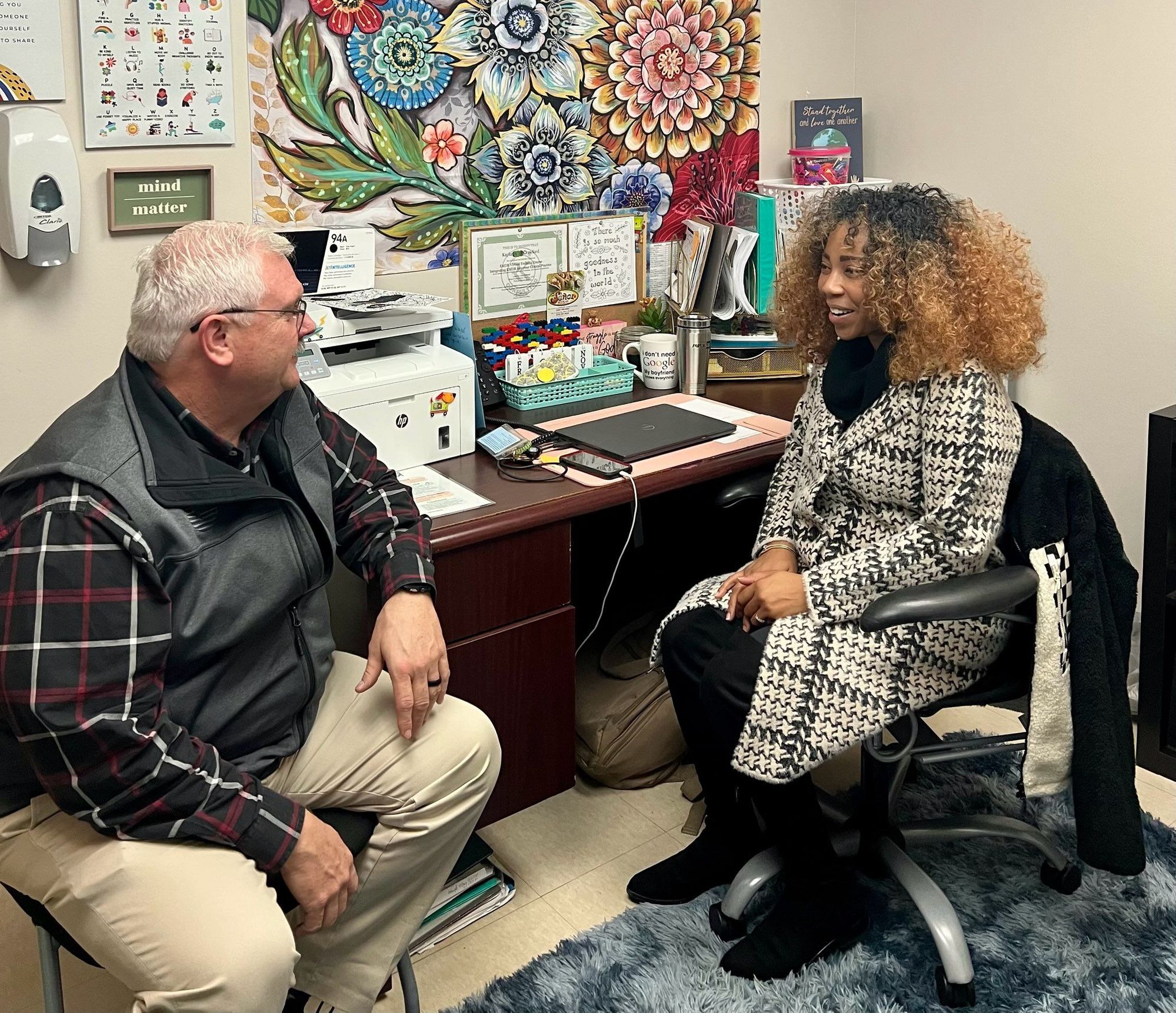
Dunklin Schools R-5 District Superintendent, Clint Freeman, with Chestnut Clinician, Kayla Crawford
Over the years, a quiet crisis unfolded in Jefferson County, MO as several students died by suicide, leaving communities devasted and searching for answers.
The loss was heartbreaking—and it was clear that something had to change.
“There really wasn’t an effective comprehensive behavioral health response,” said Jim Wallis, Director of Business Development – Missouri, Chestnut Health Systems™.
To combat the crisis, the Jefferson Foundation, a local non-profit that supports charitable and educational initiatives to improve community well-being, approached Chestnut about funding a grant that supported a school-based program.
School-based programs are effective, short-term interventions for a variety of behavioral health difficulties experienced by youth. The grant would allow Chestnut staff to work with students and families to cope with issues such as depression, anxiety, grief, and trauma.
With experience running a school-based program in Illinois, Chestnut saw the opportunity not to just intervene in Jefferson County, but to build something transformative.
“That was the first program we decided to replicate,” explained Wallis. “It’s very successful in the Metro East area.”
Chestnut received the initial grant funding in September 2019. It would begin providing youth behavioral health services in Jefferson County, launching the initiative that would soon become a lifeline for struggling students. In addition, adult services for behavioral health concerns were funded to support individuals in need throughout the community.
By January 2020, Chestnut brought on its first Missouri employee, Lori Epley as the director of the program dubbed Project Access. One month later, the first clinical service was delivered to a school in Jefferson County.
Then, COVID-19 happened.
“We started a week before schools shut down [in 2020],” said Wallis. “Our challenge was building relationships with school personnel, as well as families and students.”
Without the ability to meet face-to-face, the team had to get creative. “Our staff had to navigate through virtual intakes or building rapport with a child and their parents over the phone,” said Epley.
Most people see the program as it stands today—fully operational and making an impact—but what they don’t see is the tireless effort, planning, and persistence it took to get it there.
Today, Chestnut's school-based program serves fourteen schools across ten districts, including two private schools. The model is simple but powerful: clinicians meet students during school hours for one-on-one sessions to help them navigate their issues.
Madeline Huelskamp, a clinician in the Jefferson R7 District, sees firsthand how meaningful that access can be.
“A lot of my kids are struggling with anxiety, peer relationships, impulse control, and the beginning stages of substance use,” said Huelskamp.
Students are typically referred by a guidance counselor, who notifies the office that they need more intensive services. The school then contacts the parent or guardian to explain the concern and obtain consent. Once obtained, the school reaches out to Chestnut. Sessions are 50 minutes long and held during the school day, removing barriers like transportation and scheduling.
“What I like most is working with the kids one-on-one,” said Huelskamp. “It feels like a partnership. I noticed my kids have a lot of anxiety, especially in academic settings. We’re able to work through things together in that exact setting and it really helps further develop their skills.”
The impact of the school-based program extends beyond the four walls of the clinician’s office. Parents and communities see real change.
“This program is a blessing,” said a mother in the Fox School District in Arnold, MO. “There were many days when my child was able to stay at school and still get the help he needed to work through emotional stressors without accruing absences that would have caused more stress.”
Five years into the program, staff remains committed to growing. With continued support from the Jefferson Foundation and the Jefferson County Community Mental Health Fund Board, the team has been able to sustain the program and expand services.
“We need to continue building relationships with current school districts and have conversations with other districts,” said Epley. “We want to support staff in whatever they need and eventually hire more staff as necessary."
Alongside the school-based program, the Missouri team offers a variety of resources, such as adult outpatient treatment and Psychiatric-Mental Health Nurse Practitioner services. As of April 2025, they have served 2,077 clients. As Chestnut’s Missouri school-based program looks ahead, the mission remains the same: to reach more students, break down more barriers, and continue being a source of hope.
Behind every referral, every 50-minute session, and every relationship built, is a child who is seen, supported, and no longer endures in silence.
If you know of a school district that would benefit from school-based services, please reach out to Jim Wallis at jwallis@chestnut.org or Lori Epley at ljepley@chestnut.org. For more information about services provided by Chestnut, please visit chestnut.org.